
The alchemy of imagery: using theme-specific language to capture raw emotion
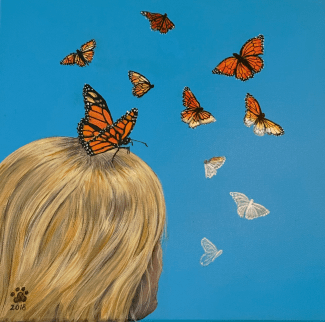
A few years ago, I received a wonderful surprise: my poem “Butterfly House” was awarded an Honorable Mention in the 86th Annual Writer’s Digest Writing Competition. The poem, which appears in my collection The Dragon & The Dragonfly, was one of those rare pieces that poured out of me in a single, fluid sitting.
But looking back on it now, I realize it wasn’t just a stroke of luck. It worked because of a fundamental rule of powerful writing: letting a specific theme provide the exact vocabulary for your emotional landscape.
The story behind the poem
It was November 4th, my late husband’s birthday. Seeking a way to honor my grief and celebrate his memory, I decided to visit the Tropical Butterfly House at the Pacific Science Center in Seattle. I had only learned about the exhibit a week prior, but I knew I had to go. I wanted an adventure to honor his transition into whatever comes next, and to acknowledge my own messy, painful struggle to find a new life for myself.
The experience was pure magic. I remember standing perfectly still, arms outstretched, just waiting. Several butterflies fluttered past, but one—a massive, striking monarch—landed right on my hair and stayed. For a brief moment, the heavy weight of loss lifted.
In many Indigenous cultures, the butterfly is a profound symbol of change, joy, and transformation. It represents the miracle of resurrection—the exact medicine I needed that day.
The craft: writing without sentimentality
When we experience massive, earth-shattering emotions like grief, heartbreak, or profound joy, our instinct as writers is often to reach for massive words: heartache, soul, forever, shattered, devastating.
The problem? These words are abstract. They are sentimental shorthand. They tell the reader what to feel instead of making them feel it.
Instead, the most powerful prose and poetry use theme-specific language to let the setting do the heavy lifting. In “Butterfly House,” I didn’t write about the agony of losing a spouse. Instead, I borrowed the physical reality of the exhibit and the biology of the insects to mirror my internal state.
- Stanza 1 & 2 (The weight of grief): To capture the fragility of early loss, I used the physical rules of the museum: “tread lightly,” “need to rest,” “something solid beneath them,” “self-repair,” “damaged,” “missing pieces.” These are biological realities of butterflies, but they perfectly describe a grieving human being.
- Stanza 3 (The transition): The poem shifts with the introduction of the “chrysalis.” It acknowledges the brevity and preciousness of time.
- Stanza 4 (The rebirth): The language bursts open into renewal: “wonder,” “quivering,” “spring,” “new life,” “free.”
I didn’t outline this vocabulary ahead of time. I simply leaned heavily into the environment I was in. By focusing entirely on the physical details of the butterfly house, the emotional truth emerged naturally.
How to apply this to your own writing (poetry and prose)
Whether you are writing a poem, a personal essay, or a scene in a novel, you can use this exact technique. Start with the core emotion you want to convey, and then select a highly specific backdrop. Let that backdrop dictate your vocabulary.
Example 1: grief via architecture (prose)
If a character is dealing with a family breakdown, instead of writing “She felt her family dynamic eroding,” anchor the scene in a renovation project. Use architectural and structural terms:
“The foundation was shifting. They spent years trying to patch the drywall, ignoring the load-bearing beams that were slowly buckling under the weight of everything unsaid. By winter, the structural integrity was gone.”
- Theme-specific words: foundation, drywall, load-bearing, buckling, structural integrity. The emotion is devastating, but the language is concrete.
Example 2: anxiety via the ocean (poetry)
Instead of writing about panic or fear using cliches, lean into the vocabulary of marine biology or deep-sea diving:
The pressure drops at twenty fathoms. The lung relies on the regulator, a mechanical gasp in the dark. Hold the breath too long and the nitrogen bubbles— a decompression sickness of the mind.
- Theme-specific words: fathoms, regulator, nitrogen bubbles, decompression sickness. The clinical, heavy language creates a claustrophobic feeling of anxiety without ever naming the emotion.
Trust the imagery
When you sit down to write, look around. Find an image, a setting, or a hobby that interests you, and raid its dictionary. If you are writing about a rocky relationship and your character loves gardening, use words like pruning, root-bound, blight, or perennial.
By restricting your vocabulary to a specific theme, you force yourself away from cliches. You give your reader something solid to stand on.
Have you ever visited a place that unexpectedly gave you the exact words or imagery you needed to process a major life transition? Where was it, what were some of the words that came to you, and what did it teach you?
Here is the poem that taught me that lesson:
Butterfly House
Pacific Science Center, Seattle
November 4, 2016
The sign says tread lightly
because butterflies might land
on the stone path. I understand
their need to rest, to feel something
solid beneath them.
Another sign warns not to touch them—
they can’t self-repair damaged wings
but can still fly with missing pieces.
I stand still. A black and orange monarch
lands on my yellow hair.
After 9 months in its chrysalis,
the monarch will only live
a few days to a couple of weeks.
Can it smell my wonder?
Does it sense the butterflies inside me—
a thousand wings quivering for spring,
preparing for new life?
I open my mouth to set them free.
If this post resonated with you, please consider sharing it with a fellow writer or leaving your thoughts below. I read and cherish every single comment!
(The image above is a painting by local artist Patty A. Watson created to go along with my poem for Ars Poetica. Isn’t is amazing?)


 onewildword