
Breaking the barrier: how to eliminate filtering verbs and master deep point of view
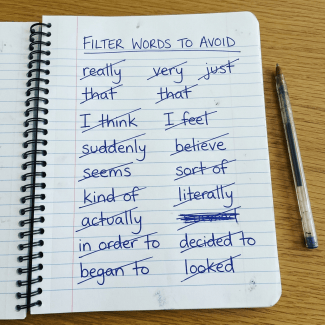
We’ve all heard the classic writing advice: Show, don’t tell. It’s a golden rule for a reason, but when you’re transitioning from an intermediate writer to an advanced storyteller, there are subtle, sneaky culprits that keep your prose from achieving true intimacy.
They are called filtering verbs.
Words like saw, heard, felt, noticed, realized, and thought.
On the surface, they seem harmless. They simply describe what your character is experiencing. But filtering verbs act like a glass wall between your reader and your protagonist. Every time you write “She heard the floorboard creak,” you’re reminding the reader that they are sitting in a chair, reading a book about a person hearing a sound.
If you want to pull your reader entirely inside your character’s skin, it’s time to break the glass. Welcome to the world of Deep Point of View.
What is filtering and why does it weaken your prose?
Filtering happens when a writer places the protagonist’s senses between the reader and the action. It creates a narrative distance. Instead of experiencing the world through the character, the reader is watching the character experience the world.
Let’s look at a quick comparison:
Filtered: She looked out the window and saw the storm clouds rolling over the mountains. She felt a chill run down her spine and thought to herself that they were running out of time.
Notice how many layers are packed into those two sentences? She looked, she saw, she felt, she thought. We are watching her like a camera crew.
Now, let’s strip the filters away:
Deep POV: Storm clouds bruised the sky, heavy and low over the mountain peaks. A chill raced down her spine. They were running out of time.
By removing the filters, the description becomes immediate. The reader doesn’t need to be told she saw the clouds because the clouds are described, we already know she’s looking at them. The narrative voice merges entirely with the character’s internal reality.
Five common filtering verbs to cut:
When you dive into your next revision pass, keep a sharp eye out for these frequent offenders. Here is how to transform them from distant to immersive:
1. The visual filters (saw, noticed, watched, looked)
- Filtered: He noticed a shadow move near the alleyway.
- Deep POV: A shadow detached itself from the brick wall near the alley.
2. The auditory filters (heard, listened to)
- Filtered: She heard the distant wail of a siren.
- Deep POV: A distant siren wailed, sharp and piercing through the quiet street.
3. The physical/emotional filters (felt)
- Filtered: He felt his heart hammer against his ribs in fear.
- Deep POV: His heart hammered against his ribs, a frantic, trapped bird.
4. The internal filters (thought, realized, wondered)
- Filtered: She wondered if he was lying to her.
- Deep POV: Was he lying to her? The sudden stiffness in his shoulders suggested he was.
How to practice Deep POV this week:
Stepping into Deep POV requires a shift in mindset. You have to stop acting as the narrator who explains the scene and start acting as the character who is living it.
You must learn how to write from the inside out as the character, not from the outside in as the author.
As you draft or edit this week, try this three-step exercise:
- Run a search: Use the “Find” feature in your writing software and search for saw, heard, felt, and realized or whatever filter words you know you tend to use.
- Locate the source: Look at what the character is reacting to. Is it a sound? A sight? A sudden internal epiphany?
- Paint the reality: Rewrite the sentence by describing the thing itself or the direct physical reaction, deleting the character’s sensory middleman entirely.
Mastering Deep POV takes practice, but the payoff is immense. It transforms your manuscript from a story being told into an experience being lived.
I don’t worry about filter words during my first draft but they’re definitely something I check for in later drafts. The good news is the more I hunt and peck filter words, the better I get at not even using them in the first place.
What are your favorite tricks for getting closer to your characters’ internal worlds? Do you find yourself leaning on a specific filtering verb more than others?


 onewildword