Skip to content

Posts by Carly Sandifer

Create a chaos board to capture your writing ideas

When I’m working on a new project, my mind spins. I make connections from all the whirling ideas and even think of totally unrelated ideas that I might turn into a story or poem. I capture these images and ideas on whatever I have at hand. If I don’t have a notebook nearby, I write on an index card, envelope, or a sticky note.

It feels chaotic to have all this creative flotsam floating around. So when I read about something that author Debra Marquart did to corral her bits and pieces of ideas, I knew I had to try it.

When she was working on her memoir during an artist’s residency at the Ragdale Foundation, she created a chaos board. Read more

How writing anything in your notebook is a promise to your muse

If you ever feel stuck, out of ideas, or simply so busy you can’t fit in the writing time you wish for, know this: Your muse will reward you if you write anything at all in your notebook.

Something about writing even a word or describing an image reassures your subconscious that you’re present and engaged. By this very act of recording a snippet of conversation or a description of a scene, you’ll reinforce your connection to your writing self.

You’ll retain your momentum. You won’t feel such a gap in your writing practice, and your muse will present you later with ideas and images that you can use in your current or future writing.

Exercise: Double-check you’re carrying a notebook with you today. Maybe you’ll only have 20 minutes while you’re waiting for an appointment or 15 minutes while you wait to pick up a child from school. It’s enough time to write down an image, a description that might go in your current manuscript, or something you’ve observed as you go about the day. Write it down and then spend five or ten minutes letting your mind drift. Think about it and let it develop in your mind. I guarantee you’ll feel happier and on track with your writing, even if you don’t have as much time to write as you wish you did.

Listen to your characters and use these six dialogue tips to advance your story

Writing dialogue is more than just putting words in your characters’ mouths. Try listening to your characters and find out what they have to say to tell the story. By using this practice of listening, you may find unexpected meaning and your story may go in surprising but satisfying directions.

Here are six tips for writing dialogue:

Show instead of tell. Craft dialogue that shows feelings instead of specifically stating how the characters feel. Whenever you start to use the word “felt,” stop and see how you can show that emotion through dialogue instead of telling the reader how your character felt. This showing technique will put the reader squarely in the action.

Advance the story’s meaning with descriptions of character movement and body language. Show how characters gesture, sit, stand or move around as they talk and how their body language mirrors inner emotions.

Don’t let your characters directly answer each others’ questions. A more indirect approach hints at the story below the surface and adds depth.

Read more

Be a writer activist by penning a love letter to a stranger

Hannah Brencher believes the world could use a little more love. And she believes in the power of the written word to spread it.

Brencher grew up receiving handwritten letters from her mother. When she became depressed in college, she found recovery in writing love letters for strangers to find. Her campaign has become a global initiative, The World Needs More Love Letters, which sends handwritten letters to those in need of a boost.

If you believe in the power of the pen and paper, watch the 5-minute video, then visit MoreLoveLetters to learn more about how you can spread love in your community and the world.

For another way to spread global understanding with your pen, read my post, Write a postcard to spread global understanding.

Get set for NaNoWriMo with these tips

November is almost here and that means National Novel Writing Month kicks off. If you haven’t heard of it, NaNoWriMo is a month-long writing project in which writers write a 50,000-word draft of a novel in 30 days.

Novels can be any genre or language. Planning and extensive notes are allowed but pre-written material can’t go into the body of the novel for it to count. To complete the project in 30 days, you’ll need to write an average of 1,667 words a day.

A deadline is one of the best incentives to get writing and NaNoWriMo can help writers get into that non-analytical state of mind and write a draft from start to finish, a key step to ultimately finishing a novel.

While most novels are longer than 50,000 words, meeting the goal and “winning,” can mean writing a 50,000-word novel or the first 50,000 words of a novel to be finished later. According to Wikipedia, notable novels of roughly 50,000 words include The Ultimate Hitchhiker’s Guide to the Galaxy, Brave New World, and The Great Gatsby.

Here are a few tips for writing massive numbers of words in 30 days. Read more

How to reveal character personality through speech

Your characters’ speech reveals volumes about their education, personality, and where they grew up. A character who was reared in the deep South will speak with a different accent and use different slang than one who grew up in the Midwest. When it comes to creating distinct characters in the readers’ minds, using slang — without overdoing it — can help form a character’s personality.

My friends and family have lived in a variety of places, so I’ve picked up on slang from the West and southern United States, as well as British slang from my friends who hail from the United Kingdom. My Midwestern friends say hot dish while my family in the Western U.S. call it casserole. Depending on where you’re from, you might say “pop” where others say, “soda” or “soda pop.” Some of my friends say sofa and others couch.

Here are several examples. Interestingly, I’ve noticed that slang can migrate as people move from one part of the country to another.

Here’s what my southern friends say:

Fit to be tied — frustrated, angry, agitated

Fixin’ – about or getting ready. “I’m fixin’ to go to school.”

Hunkey Dorey — everything is fine.

Hankerin’ for – a desire/craving for where my British friends might say they “fancied” something.

My British friends have been known to use these expressions: Read more

Write a postcard to spread global understanding

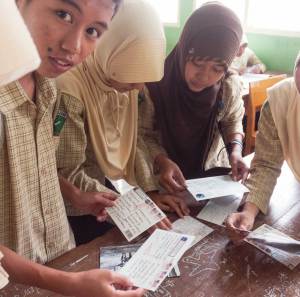
The written word is a powerful way to increase empathy and understanding on a global scale. Writers can be activists in many ways. One of those opportunities is through a program started by Peace Corps volunteer and teacher Matthew Borden.

Borden started a project called Postcards to Java as a way to help his students practice their language skills and learn more about people in other countries. The project is designed to address Peace Corps’ three goals. The Peace Corps focus on Java is English education and the program provides students with the opportunity to practice their language skills.

The students hope to receive postcards from all 50 states and from all over the globe. Participants are asked to write students a postcard in English. The students read the postcards and then write back. One international stamp in the United States only costs $1.10.Postcards to Java_children Read more