Skip to content

Posts tagged ‘poetry’

The art of the critique: how to give writing feedback that actually helps (part 1)

Sharing your writing with another person is, quite frankly, terrifying. Whether it’s a rough draft of a poem or the first few chapters of a novel, handing over your work feels like handing over a piece of your soul.

Because we know how vulnerable this process is, we often fear critique groups. We worry we will be ripped apart, or that we will unwittingly discourage someone else. But constructive feedback is the fuel that makes us grow. Without outside eyes, we are blind to our own habits, plot holes, and stylistic stumbles.

Over the years, I have learned that giving good feedback is its own art form. It is not just about having a critical eye—it is about communication, psychology, and respect.

In this two-part series, we are going to master both sides of the coin. Today, we focus on Part 1: How to deliver feedback to other writers that empowers them, rather than puts them on the defensive.

Here are the guiding principles I use every time I read someone else’s work.

Read more

How to keep your story running in the background of your mind

For years, my brain had a default setting. No matter what I was doing—folding laundry, sitting in a waiting room, or driving—the “background app” running in my mind was business. I was constantly triaging to-do lists, marketing strategies, and logistics.

It was productive, sure. But it was also killing the magic.

Over the last few years, I’ve made a conscious, radical shift. I’ve closed the “business” tab and opened the “story” tab. Now, when the world gets loud or the chores pile up, my manuscript is what hums in the background. This mindset switch has changed everything for my consistency.

Making the mindset switch

We are often told to “treat writing like a business.” While that’s great for hitting deadlines, it can make the act of creation feel like just another chore on the list. When your writing is the first thing to get cut during a crisis—like a surgery or a season of caregiving—it’s usually because we’ve categorized it as “work” instead of “life.”

By letting the story run in the background, you aren’t just a writer when you’re at the keyboard. You’re a writer while you’re washing the dishes or taking the dog for a walk.

Tips for dreaming into your story

Read more

Want to be a better literary citizen? Six things I learned by sending my poems out into the world

Happy National Poetry Month!

After a long hiatus, I recently started sending my poems out into the world again and in doing so, I learned several things that are helping my literary career that I wanted to share with you.

First, the reason I hadn’t been sending my poems out is because it always felt like drudgery to me. All that left brain work made me feel overwhelmed. Plus, I’m a busy business owner! I mean, who has time for one more thing to do, right?

After hearing one of my poetry mentors say she, too hated sitting down to send out her work (and she’s a HUGE award-winning poet), I didn’t feel so bad. What works for her, she said, is to sit down once a month or so and do an afternoon of submissions. I thought, “I can do that.”

I chose a Saturday and sent out 20 poems to eight different literary magazines. I created a short artist bio that I could use for each submission. Then I found a simple Google Sheet online from another poet that I used to track my submissions, including the name of the poem, where it’s been submitted, when I submitted it, when they typically reply, a column to note if it’s been accepted or rejected, and a column for the magazine’s website link.

Normally, my left brain would be balking at these types of activities, but it was kind of fun.

Next, I basically forgot about all this and went back to work on my other projects. Over the next two months, I got several rejections and six acceptances (six poems in two magazines). Pretty cool!

What did I learn?

Track your submissions. Whether you’re sending out poems, short stories, novels, photography, or paintings, you’ll save so much time if you have a simple tracking system and an artist bio ready.

Treat it like a job. Submitting your work is part of your job as a good literary citizen. We create work so others can read it and benefit from it, right? If you’re not sending out your work, you’re not enriching others’ lives.

Ask for what you want. A wise person once told me, “If you don’t ask, you won’t receive.” People are not mind readers. We must ask for what want in our lives. For artists, that includes sending your work out to be seen and published. If we don’t send our work out, it won’t be published. Ever.

Have no emotional attachment to outcome. When I was a young poet, I took rejections hard. Each rejection was like an ice pick in my heart. Over time, I developed a thick skin and just keep sending my work out. Eventually, I got a poem published, and then another, and another. If I had let my emotions get the best of me, I probably would have stopped sending my work out, and my poetry life might have dried up. As artists, I firmly believe we need that interaction with our community to help us grow and become better humans and artists.

Find passion for your bigger projects. I’ve been working on a novel which is a very long, time-consuming process. But now, by sending my shorter works out and getting some published, it gives me a little reward, a hit of pleasure, while I keep slogging away at my larger work. This feeling of satisfaction gives me more pleasure and passion for my bigger project, too. It’s like a little zap of energy.

Join an artistic community. This will sustain your muse and feed your passions. At the end of January, I joined a poetry community and subscribed to a newsletter where I receive poetic inspiration, writing prompts, lesser-known places to submit work to, and more that has helped me become a better poet and literary citizen. (If you’re a poet and would like a free month of this newsletter, let me know. The two poets who put out the weekly newsletter gave me a few links for friends and I have one left).

I hope my experience helps you see the importance of putting your work out into the world. If you’re working on a novel or memoir, look for opportunities to submit shorter works such as poems, short stories, or flash fiction, etc. to literary journals.

Another benefit is you’ll start building up your artist resume, which might come in handy when your book is ready for publication.

Activity: Write in your journal about what it means to be a good literary citizen. I’ll share my ideas in my next post.

You can see some of my poems at CDFawcett.com.

My Poetry Book https://amzn.to/40aVhxz
One tip to tweak your morning routine to become happier and more creative

Recently, I had a major epiphany about how to tweak my morning routine to become more creative, happier, and joyful.

But, first, the morning routine.

I learned a few years ago about the power of having a morning routine in Hal Elrod’s book, “The Miracle Morning: The Not-So-Obvious Secret Guaranteed to Transform Your Life (Before 8AM).”

The author writes about the many benefits of a morning routine such as waking up every day with more energy, drive, and structure; lowering stress levels, improving health, increasing productivity, and having more gratitude and less anxiety.

He lists six activities to include in your morning routine that he calls “savers.”

The term SAVERS stands for:

  • Silence (meditation/prayer)
  • Affirmations
  • Visualization
  • Exercise
  • Reading
  • Scribing (journaling)

The idea is to spend the first hour of your day on these items. On those days that you don’t have an hour then you can condense your routine into whatever time you have.

I won’t go into all the details because there are so many great articles on this topic already, including this one by Ricardo Singh, “Miracle Morning routine: 6 steps to boost productivity.”

I don’t do all six items but use them more as a menu to choose from depending on how I feel and what I think I need that morning.

My morning routine is the foundation of my day and without it, I feel lost at sea, afloat on a wave of too many responsibilities and tasks. That time to myself in the morning centers me for the day, and I feel as if time expands for me as a result—not in some woo-woo, supernatural way but because I’m more focused and productive.

So, what’s my epiphany?

Read more

Symbolism in literature: Is a rose just a rose?

In her poem, “Sacred Emily,” Gertrude Stein wrote, “Rose is a rose is a rose is a rose.” This line is often interpreted as meaning things are what they are. In Stein’s view, the sentence expresses the fact that simply using the name of a thing already invokes the imagery and emotions associated with it.

In literature, objects can simply be what they are or they can symbolize something more than what they are.

A symbol is anything that hints at something else, usually something abstract, such as an idea or belief. A literary symbol is an object, a person, a situation, or an action that has a literal meaning in a story but suggests or represents other meanings.

If you want to learn more about crafting symbols in your story and how to use poetic techniques to deepen your prose, please join me this Thursday, April 21 for my writing webinar Sound and Symbol: How to Use Poetry to Deepen Your Prose, which is part of the Free Expressions Literary Series.

I’ll dive deep into how poetry can add sensory engagement to your prose.

We can have general symbols—like the aforementioned rose—and we can have specific symbols.

A general symbol is universal in its meaning. Even if the symbol was removed from a work of literature, it would still suggest a larger meaning, i.e. the rose symbolizes romantic love throughout time.

Read more

Elevate your prose with poetry techniques

No matter what you write—emails, short stories, novels, or nonfiction—your prose can be more persuasive and impact your reader more effectively by using poetic devices.

Below are three blog posts to help you discover the power of using rhetorical techniques to create more poetic prose.

This Thursday, May 13, I’d love to have you on my webinar Adding Poetry to Your Prose.

You can buy the entire webinar series featuring well-known writers, including Donald Maass, Emma Dryden, and James Scott Bell, or scroll down to May 13 and grab my webinar. If you can’t make it live, you’ll receive the recording and all my handouts afterwards.

I’d love to see you there!

Until then, please enjoy these posts:

Use rhetorical devices to evoke readers’ emotions

Rhetorical devices: Your secret writing weapon

Add alliteration to make your pages pop!

Free craft webinar: Writing tips from top teachers

As writers, we know that learning our craft is a lifelong endeavor. Even well-known published authors still study their craft. These craft masters want to become the best they can be.

After I earned my Master of Fine Arts in Creative Writing, I continued my craft studies with various teachers and felt as if I got an entire second degree. I love writing. I love learning about writing. I love practicing my storytelling techniques.

If you’re a writer, I know you feel the same way, and I have a gift for you.

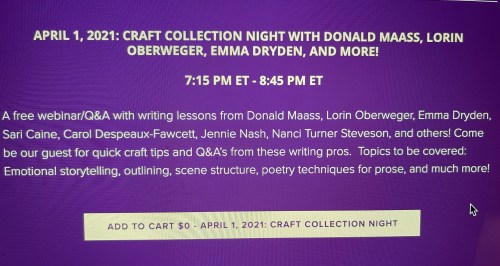
Some of my writing mentors and friends and I are teaching in-depth writing craft webinars this year. You’re invited to a FREE webinar on Thursday, April 1 for a sneak peek of what we have to offer. Be our guest for quick craft tips, writing exercises, and Q&As from writing pros. Topics include emotional storytelling, outlining, scene structure, poetry techniques for prose, and much more.

To sign up for the FREE Craft Collection night, please click here and scroll down to the April 1 event.

Free Writing Webinar – April 1 – 4:15 p.m. to 5:45 p.m. PDT

On May 13, I’m teaching a webinar on adding poetry to your prose. Other webinar topics in the series include Writing Your Novel from the Middle by James Scott Bell, Backstory is Fore-story by Donald Maass, Emotional Storytelling by Lorin Oberweger, Dialogue as Action by David Corbett, Character Matters by Sheree Greer, Crafting Your Novel by Emma Dryden and many more!

I hope to see you on April 1.

P.S. If you miss the free event, you can check out the webinar series here.