Skip to content

A premise sentence can keep your writing on track

Ever heard the saying, “Ideas are a dime a dozen?” While it’s true that ideas can be found everywhere we look, it’s not true that every idea is worthy of a story or can sustain an entire novel. That’s why I like to write in a variety of mediums: poetry, short story, novels, even songs. Most of my ideas can find a home in one of these genres.

But how do you know if your idea can sustain a novel?  One way to do this is by writing a logline or a premise statement. Whatever you want to call it, this is a one- to two-sentence summary of your story that includes the protagonist or hero (including a type of person and an adjective that describes him), his goal, the antagonist, the main conflict, and action (plot).

In “Outlining Your Novel: Map Your Way to Success,” K.M. Weiland calls her one-liner the premise sentence. Here’s her premise sentence for her novel Dreamlander: Read more

How to reveal character personality through speech

Your characters’ speech reveals volumes about their education, personality, and where they grew up. A character who was reared in the deep South will speak with a different accent and use different slang than one who grew up in the Midwest. When it comes to creating distinct characters in the readers’ minds, using slang — without overdoing it — can help form a character’s personality.

My friends and family have lived in a variety of places, so I’ve picked up on slang from the West and southern United States, as well as British slang from my friends who hail from the United Kingdom. My Midwestern friends say hot dish while my family in the Western U.S. call it casserole. Depending on where you’re from, you might say “pop” where others say, “soda” or “soda pop.” Some of my friends say sofa and others couch.

Here are several examples. Interestingly, I’ve noticed that slang can migrate as people move from one part of the country to another.

Here’s what my southern friends say:

Fit to be tied — frustrated, angry, agitated

Fixin’ – about or getting ready. “I’m fixin’ to go to school.”

Hunkey Dorey — everything is fine.

Hankerin’ for – a desire/craving for where my British friends might say they “fancied” something.

My British friends have been known to use these expressions: Read more

What should you write? How about writing your favorite novel?

When starting a new novel or story, it’s a good idea to know what genre you’re writing in. That’s pretty obvious. What may not be so obvious are all the nuances within your genre. What kind of story, exactly, are you telling?

One way to discover this is to ask yourself: What are some of your favorite novels or movies and why do you like them? What makes them stand out above the others?

Below I listed a few of my favorites and why I like them. My “why” may be different than yours.

Books:

Lovely Bones by Alice Sebold.

Why: original pov (from dead girl), lovely prose, deeply creepy antagonist, unique setting: heaven.

Secret Life of Bees by Sue Monk Kidd Read more

Write a postcard to spread global understanding

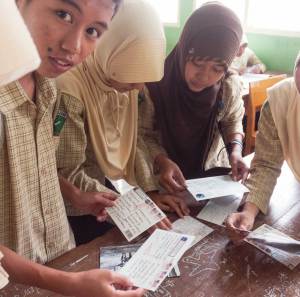
The written word is a powerful way to increase empathy and understanding on a global scale. Writers can be activists in many ways. One of those opportunities is through a program started by Peace Corps volunteer and teacher Matthew Borden.

Borden started a project called Postcards to Java as a way to help his students practice their language skills and learn more about people in other countries. The project is designed to address Peace Corps’ three goals. The Peace Corps focus on Java is English education and the program provides students with the opportunity to practice their language skills.

The students hope to receive postcards from all 50 states and from all over the globe. Participants are asked to write students a postcard in English. The students read the postcards and then write back. One international stamp in the United States only costs $1.10.Postcards to Java_children Read more

Self or traditional publishing? Important insights from hybrid publisher Hugh Howey

Self or traditional publishing?

It’s the big question most writers are considering no matter what point they’re at in their writing. Writers have more options than ever with all the changes in publishing in the past five years.

As I’ve been learning about the paths to publishing, I’ve been struck by insights from hybrid author Hugh Howey that you might find helpful as you build your writing career. Howey is known for his popular series Wool, which he independently published with great success through Amazon.com’s Kindle Direct Publishing system. Wool – Part One is currently available for free.

In 2012, Twentieth Century Fox bought the film rights to Wool, and Howey signed a deal with Simon and Schuster to distribute Wool to book retailers across the U.S. and Canada. The deal allowed Howey to continue to sell the book online exclusively. He turned down seven-figure offers and instead opted for a mid six-figure deal in order to retain e-book rights.

In a blog post by Porter Anderson on Publishing Perspectives yesterday, Anderson asked Howey to offer advice for self publishers. Here’s one piece of it:

1. Asking people to buy your book doesn’t work. Instead, try to entertain or enlighten with your Facebook posts and tweets. Read more

Learn how outlining techniques can help you find your story (and have fun)

I just finished reading one of the most helpful books on writing I’ve ever read—and that’s saying a lot considering how many titles decorate my shelves.

But I hesitate to tell you the title. You might faint. You might freak out. You might jump back from your computer screen or iPhone or whatever device you’re reading this on and chuck it out the nearest window.

One word, in particular, in this book’s title is generally known to make writers quake in their pink bunny slippers as if they are witnessing a wolf spider crawl up the bathtub drain. Read more

Add depth to your novel or memoir with this structural technique, Part 2

In my last blog post, I wrote about how author Elizabeth Rosner used a structural technique to add subtext to her novel. In today’s post, I share an example from a memoir.

In Lisa Dale Norton’s memoir Hawk Flies Above: Journey to the Heart of the Sandhills, she wrote 12 sections called “Notebooks” that created connections between chapters. Norton’s idyllic childhood ended when her parents divorced when Norton was 12. After 13 years of drifting, attending college, and surviving a rape where she was left for dead, Norton returned to Ericson, Nebraska. She began writing stories intertwined with threads of the landscape and its impact on her imagination and identity.

Norton weaves natural images of plants, wildlife and the landscape of her childhood summer home in Nebraska with an account of her search for self as she returns to the Sandhills, her childhood home.

“By lying close to the land, skin to sand, bone to wind, I believed I could merge with the grasses, with the hills. I believed I could become whole again. I did not know this on a conscious level.” Read more