Skip to content

Posts from the ‘Writing Life’ Category

Get set for NaNoWriMo with these tips

November is almost here and that means National Novel Writing Month kicks off. If you haven’t heard of it, NaNoWriMo is a month-long writing project in which writers write a 50,000-word draft of a novel in 30 days.

Novels can be any genre or language. Planning and extensive notes are allowed but pre-written material can’t go into the body of the novel for it to count. To complete the project in 30 days, you’ll need to write an average of 1,667 words a day.

A deadline is one of the best incentives to get writing and NaNoWriMo can help writers get into that non-analytical state of mind and write a draft from start to finish, a key step to ultimately finishing a novel.

While most novels are longer than 50,000 words, meeting the goal and “winning,” can mean writing a 50,000-word novel or the first 50,000 words of a novel to be finished later. According to Wikipedia, notable novels of roughly 50,000 words include The Ultimate Hitchhiker’s Guide to the Galaxy, Brave New World, and The Great Gatsby.

Here are a few tips for writing massive numbers of words in 30 days. Read more

Four more tips to get the most from a writer’s conference

In an earlier post, “5 tips to get the most out of a writer’s conference” I describe the Action Plan I put together before each writer’s conference or event I attend.

I used to go bumbling into conferences with no clue what I wanted to get out of them except to learn as much about the craft of writing as I could.

Things are different now that I have a better grasp of my craft. Now, I think about things like networking, interviewing successful authors, and getting feedback on my work.

What if you have a manuscript ready to pitch? In addition to the tips in the post above, I also recommend the following to make sure you present your best self: Read more

Name your muse to increase creativity

“Art does not come from the mind. Art comes from the place where you dream.” – Robert Olen Butler in From Where You Dream: The Process of Writing Fiction.

The other morning, I had a dream about writing. I was definitely in my happy place when I woke because the dream starred one of my favorite authors–Neil Gaiman–who was giving me writing advice.

In the dream, my hubby and I were having a picnic on a grassy knoll in England. (I’ve never been to England so I’m not even sure what it looks like or if there really are grassy knolls). Mr. Gaiman was walking by and stopped to entertain us with the details of his next writing project.

I told him I was a writer but that I was having problems finishing my current novel. He said, “You’re getting caught up in all that other stuff that doesn’t mean anything.” Wagging his finger at me, like my mother used to do when I was young and naughty, he continued, “Just tell a story. Forget about everything else for now.”

I woke up smiling. I mean, who wouldn’t with Mr. Gaiman wagging his finger at you?  Read more

Write a postcard to spread global understanding

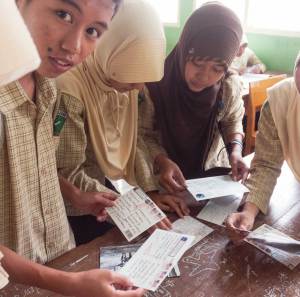
The written word is a powerful way to increase empathy and understanding on a global scale. Writers can be activists in many ways. One of those opportunities is through a program started by Peace Corps volunteer and teacher Matthew Borden.

Borden started a project called Postcards to Java as a way to help his students practice their language skills and learn more about people in other countries. The project is designed to address Peace Corps’ three goals. The Peace Corps focus on Java is English education and the program provides students with the opportunity to practice their language skills.

The students hope to receive postcards from all 50 states and from all over the globe. Participants are asked to write students a postcard in English. The students read the postcards and then write back. One international stamp in the United States only costs $1.10.Postcards to Java_children Read more

Self or traditional publishing? Important insights from hybrid publisher Hugh Howey

Self or traditional publishing?

It’s the big question most writers are considering no matter what point they’re at in their writing. Writers have more options than ever with all the changes in publishing in the past five years.

As I’ve been learning about the paths to publishing, I’ve been struck by insights from hybrid author Hugh Howey that you might find helpful as you build your writing career. Howey is known for his popular series Wool, which he independently published with great success through Amazon.com’s Kindle Direct Publishing system. Wool – Part One is currently available for free.

In 2012, Twentieth Century Fox bought the film rights to Wool, and Howey signed a deal with Simon and Schuster to distribute Wool to book retailers across the U.S. and Canada. The deal allowed Howey to continue to sell the book online exclusively. He turned down seven-figure offers and instead opted for a mid six-figure deal in order to retain e-book rights.

In a blog post by Porter Anderson on Publishing Perspectives yesterday, Anderson asked Howey to offer advice for self publishers. Here’s one piece of it:

1. Asking people to buy your book doesn’t work. Instead, try to entertain or enlighten with your Facebook posts and tweets. Read more

Learn how outlining techniques can help you find your story (and have fun)

I just finished reading one of the most helpful books on writing I’ve ever read—and that’s saying a lot considering how many titles decorate my shelves.

But I hesitate to tell you the title. You might faint. You might freak out. You might jump back from your computer screen or iPhone or whatever device you’re reading this on and chuck it out the nearest window.

One word, in particular, in this book’s title is generally known to make writers quake in their pink bunny slippers as if they are witnessing a wolf spider crawl up the bathtub drain. Read more

Add depth to your novel or memoir with this structural technique

I’m always inspired to see the many ways authors add subtext and metaphor to their stories. As I read, I like to analyze the way an author creates a page-turning story so that I can learn how to apply those techniques to my work.

In The Speed of Light, Elizabeth Rosner uses a structural element to add meaning to the story. In the novel, brother and sister Julian and Paula Perel strive to find their voices in a home where their father struggles with devastating memories as a Holocaust survivor.

A scientist who exists by numbers and routines, Julian lives an isolated life. As Julian retreats from life, Paula throws herself into the world through her study as an opera singer. Both of them change when Paula asks her housekeeper Sola, who has struggles and a devastating past of her own, to stay at Paula’s apartment and look out for Julian in the apartment above while Paula travels.

Rosner tells the story in the alternating voices of the three protagonists. Then throughout the book, she threads scientific definitions written by Julian that reveal his character and create additional depth. The definitions leave readers with another way to interpret and experience the novel. Read more