Skip to content

Posts from the ‘Writing Life’ Category

Write a postcard to spread global understanding

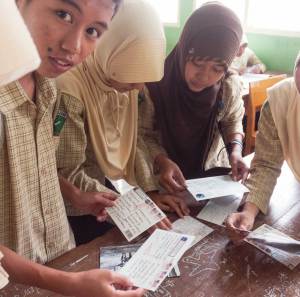
The written word is a powerful way to increase empathy and understanding on a global scale. Writers can be activists in many ways. One of those opportunities is through a program started by Peace Corps volunteer and teacher Matthew Borden.

Borden started a project called Postcards to Java as a way to help his students practice their language skills and learn more about people in other countries. The project is designed to address Peace Corps’ three goals. The Peace Corps focus on Java is English education and the program provides students with the opportunity to practice their language skills.

The students hope to receive postcards from all 50 states and from all over the globe. Participants are asked to write students a postcard in English. The students read the postcards and then write back. One international stamp in the United States only costs $1.10.Postcards to Java_children Read more
Self or traditional publishing? Important insights from hybrid publisher Hugh Howey

Self or traditional publishing?

It’s the big question most writers are considering no matter what point they’re at in their writing. Writers have more options than ever with all the changes in publishing in the past five years.

As I’ve been learning about the paths to publishing, I’ve been struck by insights from hybrid author Hugh Howey that you might find helpful as you build your writing career. Howey is known for his popular series Wool, which he independently published with great success through Amazon.com’s Kindle Direct Publishing system. Wool – Part One is currently available for free.

In 2012, Twentieth Century Fox bought the film rights to Wool, and Howey signed a deal with Simon and Schuster to distribute Wool to book retailers across the U.S. and Canada. The deal allowed Howey to continue to sell the book online exclusively. He turned down seven-figure offers and instead opted for a mid six-figure deal in order to retain e-book rights.

In a blog post by Porter Anderson on Publishing Perspectives yesterday, Anderson asked Howey to offer advice for self publishers. Here’s one piece of it:

1. Asking people to buy your book doesn’t work. Instead, try to entertain or enlighten with your Facebook posts and tweets. Read more

Learn how outlining techniques can help you find your story (and have fun)

I just finished reading one of the most helpful books on writing I’ve ever read—and that’s saying a lot considering how many titles decorate my shelves.

But I hesitate to tell you the title. You might faint. You might freak out. You might jump back from your computer screen or iPhone or whatever device you’re reading this on and chuck it out the nearest window.

One word, in particular, in this book’s title is generally known to make writers quake in their pink bunny slippers as if they are witnessing a wolf spider crawl up the bathtub drain. Read more

Add depth to your novel or memoir with this structural technique

I’m always inspired to see the many ways authors add subtext and metaphor to their stories. As I read, I like to analyze the way an author creates a page-turning story so that I can learn how to apply those techniques to my work.

In The Speed of Light, Elizabeth Rosner uses a structural element to add meaning to the story. In the novel, brother and sister Julian and Paula Perel strive to find their voices in a home where their father struggles with devastating memories as a Holocaust survivor.

A scientist who exists by numbers and routines, Julian lives an isolated life. As Julian retreats from life, Paula throws herself into the world through her study as an opera singer. Both of them change when Paula asks her housekeeper Sola, who has struggles and a devastating past of her own, to stay at Paula’s apartment and look out for Julian in the apartment above while Paula travels.

Rosner tells the story in the alternating voices of the three protagonists. Then throughout the book, she threads scientific definitions written by Julian that reveal his character and create additional depth. The definitions leave readers with another way to interpret and experience the novel. Read more

Art as activism: Project Unbreakable

Note: The links to Project Unbreakable contain emotionally disturbing material. Please consider this before clicking on those links.

Yesterday, Carly wrote a post about artists as activists—those of us, like poet Martin Espada, who feel called to make the invisible visible.

Another artist doing this same thing is photographer Grace Brown, founder of Project Unbreakable. Two years ago, Grace began photographing survivors of sexual assault holding up posters on which they quoted the words of their attackers. Since it began, the project has highlighted more than 2,000 survivors’ stories. Brown uses her art to give survivors the opportunity to heal and increase awareness of sexual assault.

Read more

Artists as activists: How will you wield your power?

Writers often write to shed light on a difficult subject, find justice, and make a difference. Some writers say it’s our duty to seek truth, speak out, and stand up for those who can’t. It’s the reason why writers are among the first to be persecuted during times of political unrest.

Poet Martin Espada, who worked as a tenant lawyer and is now a professor at Amherst College, in Amherst, Mass., says he feels it’s his duty as a poet to make the invisible visible. He calls himself a poet spy, taking notes on what will later become poems.

Espada writes about controversial issues and fights for human rights through his poetry. He writes about immigration reform, dictators, prisoners on Death Row, poverty, and 9/11 victims.

In an interview with Bill Moyers, Espada said, “There’s something about poetry that saves me. There’s something about poetry that energizes me, that brings me to another plane. That fires all the hormones, I don’t know what. Something intangible, and yet tangible at the same time. There is something to poetry and activism which has the same energizing effect.”

What will you do to wield your talent as an artist, a citizen of the world, and as a communicator, whether you’re a writer, painter, photographer, or someone who has a vision for something better?

Espada has won numerous awards, including the American Book Award, the PEN/Revson Fellowship, and the Paterson Poetry Prize. His most recent book is The Trouble Ball. For more information about Espada and his writing, visit his website.

J. J. Abram’s mystery box as metaphor for writing

In producer/director/writer J. J. Abrams’s Ted Talk below, he says his fascination with how things work and the mystery surrounding life were given to him by his grandfather.

When he was a boy, his grandfather took him to a magic store where Abrams bought a Tannen’s Mystery Magic Box. This many years later, the box has never been opened because he says it represents his grandfather to him and the infinite possibilities and hopes that his grandfather instilled in him.

Abrams believes that mystery is the catalyst to imagination. He gives the example of when he was working on the TV series “Lost.” He had 11.5 weeks to write the script, cast it, and shoot it.

Because of the short time period, he and his crew had no time to think about what the show couldn’t be. No time to think about what they couldn’t accomplish. Read more